
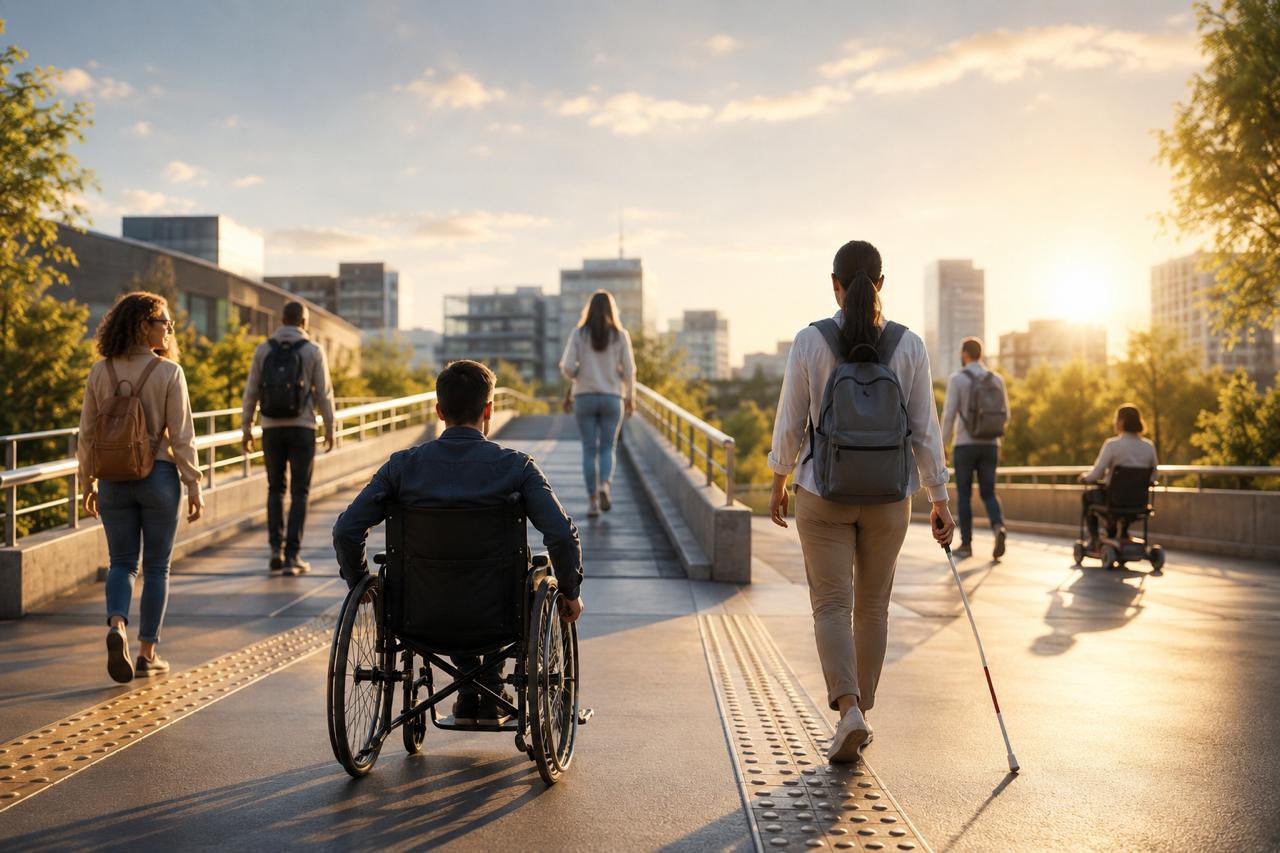
Independence is often described as a personal quality: confidence, courage, discipline, resilience. But for many people with disabilities, independence is also something much more practical. It is shaped by the door that opens automatically, the bus that has a working ramp, the website that can be used with a screen reader, the workplace that understands flexibility, and the technology that turns intention into action.
In other words, independence is not only something people “achieve.” It is something societies either support or block.
The modern understanding of disability has moved far beyond the idea that disability exists only inside a person’s body or mind. Today, disability is widely understood as the result of an interaction between a person’s health condition or impairment and the environment around them, including buildings, transport, technology, social attitudes, institutions, and support systems. When those systems are inaccessible, they do not simply create inconvenience; they actively limit participation.
That shift matters because it changes the conversation. Instead of asking, “What is wrong with this person?” we begin asking, “What barriers are preventing equal participation?” And that question leads us toward a more dignified, innovative, and inclusive future.
Disability Is Not a Fixed Experience
Two people may have the same diagnosis but live very different lives depending on the world around them.
A wheelchair user in a city with ramps, elevators, accessible buses, smooth sidewalks, and inclusive digital services may experience far fewer barriers than someone with the same mobility impairment in a place where public spaces are built without accessibility in mind. A blind student with accessible learning materials, screen reader friendly platforms, and supportive teachers may have far more educational freedom than another student who is excluded simply because information is not provided in accessible formats.
This is why diagnosis and disability are not the same thing. A diagnosis may explain a medical condition, but disability describes how much a person’s functioning, movement, communication, learning, working, or participation is limited within a particular environment.
This perspective is powerful because it does not deny the reality of impairment. Pain, fatigue, mobility limitations, sensory differences, communication barriers, and health needs can be very real. But it also recognizes that exclusion is not inevitable. Many barriers are designed into systems, and that means they can be designed out.
From “Fixing People” to Removing Barriers
For a long time, disability was mainly discussed through the medical model. This model focuses on the individual body or mind and often emphasizes treatment, rehabilitation, or correction. Medical care and rehabilitation can be essential. Many people benefit from therapy, surgery, medication, assistive devices, or professional support.
But the medical model alone is not enough.
It cannot fully explain why someone is excluded from a school because the building has stairs but no lift. It cannot explain why a talented job applicant is rejected because an employer assumes disability means inability. It cannot explain why a person cannot use an online service because the website was never tested for accessibility.
The social model of disability challenged this narrow view by showing how society itself can disable people through inaccessible environments, discriminatory systems, and limiting attitudes. The more balanced modern approach, often called the biopsychosocial model, brings these perspectives together. It recognizes that health, personal support, rehabilitation, accessible design, anti discrimination law, assistive technology, and social change can all matter at the same time.
This is where real inclusion begins: not by pretending medical needs do not exist, and not by reducing a person to those needs, but by building systems that respect the whole human being.
Accessibility Is Bigger Than Ramps
When many people hear the word “accessibility,” they immediately imagine wheelchair ramps. Ramps are important, but accessibility is much broader.
Accessibility includes physical spaces, transportation, information, communication, digital platforms, public services, education, workplaces, and social participation. The Convention on the Rights of Persons with Disabilities connects accessibility with dignity, autonomy, non-discrimination, participation, equality of opportunity, and inclusion. It also emphasizes universal design: creating products, environments, programs, and services that can be used by as many people as possible from the beginning.
A ramp is accessibility.
A captioned video is accessibility.
A screen-reader-friendly website is accessibility.
A quiet room at an event is accessibility.
A flexible work policy can be accessibility.
A clear, simple form can be accessibility.
A product designed with disabled users from day one is accessibility.
Accessibility is not a favor. It is not an act of charity. It is a standard of good design.
The Everyday Meaning of Inclusive Design
Inclusive design becomes meaningful when it changes ordinary moments.
Imagine a young professional who uses a power wheelchair. The company says it values diversity, but the meeting room is too narrow, the office kitchen is inaccessible, and the team-building event is planned in a venue with stairs. The message is clear, even if nobody says it out loud: “You are welcome in theory, but not in practice.”
Now imagine a different workplace. The entrance is accessible. The desks are adjustable. Video calls include captions. Internal tools work with assistive technology. Managers ask about access needs without making it uncomfortable. The employee is not treated as a problem to solve; they are treated as a colleague with talent, responsibility, and equal value.
That is the difference between symbolic inclusion and real inclusion.
Inclusive design also benefits more people than we often realize. A parent pushing a stroller benefits from step-free access. An older adult benefits from clearer signage. A person with a temporary injury benefits from automatic doors. Someone using a phone in bright sunlight benefits from better contrast. A tired traveler benefits from simple instructions.
When we design for disability, we often design better for everyone.
Assistive Technology Is a Bridge to Participation
Assistive technology is one of the most important frontiers of disability inclusion. It includes products and systems that support mobility, hearing, vision, communication, cognition, self-care, and daily living. This can include wheelchairs, hearing aids, communication devices, prosthetics, screen readers, braille displays, adapted keyboards, smart home tools, and AI-powered accessibility solutions.
According to the evidence overview, more than 2.5 billion people need one or more assistive products, and that number is expected to rise beyond 3.5 billion by 2050. Yet nearly one billion people are still denied access, especially in low- and middle-income countries.
This gap is not only a technology problem. It is a justice problem.
A wheelchair is not just equipment; it can be access to school, work, community, and movement. A hearing aid is not just a device; it can be access to conversation. A communication aid is not just a tool; it can be access to choice, self-expression, and decision-making.
Technology does not replace human dignity. It supports it.
Digital Accessibility Is Now Essential
Modern life increasingly happens online. Education, banking, healthcare, job applications, government services, shopping, social connection, and public information are all deeply digital. If digital platforms are inaccessible, people are excluded from everyday life.
A website that cannot be navigated by keyboard may block someone with a mobility disability. An image without alternative text may exclude a blind user. A video without captions may exclude deaf and hard-of-hearing users. A confusing layout may create barriers for people with cognitive disabilities, neurodivergent users, or anyone trying to access information under stress.
Digital accessibility is not just a technical checklist. It is a human access issue.
The World Wide Web Consortium’s accessibility guidance is built around core principles: digital content should be perceivable, operable, understandable, and robust. These principles are not only useful for disabled users; they improve quality, clarity, and usability for everyone.
In a world where digital access often means access to opportunity, inaccessible technology is a modern form of exclusion.
The Cost of Barriers Is Not Abstract
When accessibility is ignored, the consequences are real.
A student may miss education.
A qualified worker may lose employment opportunities.
A patient may delay healthcare because transport is inaccessible.
A customer may be unable to use a service.
A person may become socially isolated not because of disability itself, but because the environment was never designed with them in mind.
The evidence shows that disability is connected with serious inequalities in health, education, employment, and income. These inequalities are not random. They are often produced by inaccessible systems, poverty, discrimination, and lack of support.
This is why accessibility should never be treated as an optional upgrade. It is part of how societies create equal opportunity.
Nothing About Us Without Us
One of the strongest principles in disability rights is simple: decisions that affect disabled people should not be made without disabled people.
This matters in policy, product design, architecture, technology, healthcare, education, and community planning. Too often, accessibility decisions are made by people who have good intentions but no lived experience of the barriers they are trying to address.
Consultation is not just asking for feedback at the end. It means involving disabled people from the beginning: in research, design, testing, leadership, and decision-making. It means paying people for their expertise. It means recognizing lived experience as knowledge.
When disabled people are included as designers, founders, policymakers, engineers, educators, and leaders, the result is not only more inclusive. It is more honest.
A Better Future Is Built, Not Promised
The future of disability inclusion will not be created by kind words alone. It will be created through accessible infrastructure, inclusive technology, enforceable rights, better data, affordable assistive products, universal design, and cultural change.
It will also require a deeper shift in attitude.
Disabled people do not need to be treated as symbols of inspiration simply for living their lives. They need access, respect, opportunity, and the freedom to participate on equal terms. They need systems that do not demand extraordinary resilience just to complete ordinary tasks.
Independence is not about doing everything alone. It is about having choice. It is about control over one’s life. It is about being able to study, work, travel, communicate, create, rest, contribute, and belong.
When we build accessible societies, we do more than remove barriers. We expand what independence can mean.
Conclusion: Accessibility Is a Form of Respect
Disability inclusion is not only a policy issue or a design challenge. It is a question of dignity.
Every inaccessible building, website, service, or attitude sends a message. But every accessible design decision sends a message too: “You were considered. You belong here. Your participation matters.”
That is the future we should be building — not a world where disabled people are expected to adapt endlessly to exclusion, but a world where environments, technologies, and institutions are designed for human diversity from the start.
Because independence is not created by willpower alone.
Independence is designed.
